1. The models and labs
We ran an anonymous survey to find out which AI labs were excelling at creative systems and which were falling behind. The responses varied, and some of the results surprised us.
When we asked users for their favorite models, Z.AI's GLM-5.1 won by a landslide, picked by about 59% of respondents. GLM-4.7 and MoonshotAI's Kimi K2 Thinking followed. The full leaderboard is below.
2. Themes and ethics
We scanned 1.2K user-generated chats and used an LLM to classify each one by theme, which shows what actually happens in a typical chat session. The top two themes are drama and romance. That suggests most users are writing dramatic, eventful stories with AI, and a large share are roleplaying a romantic relationship with it.
That raises ethical questions about AI in this context, and about the guardrails needed to keep models from becoming genuinely sycophantic.
3. The benchmarks
Earlier in 2026 we built an evaluation suite called Lychee, and its first benchmark, WriterBench. WriterBench measures a model's creative writing ability using an LLM-as-a-judge method, with MoonshotAI's Kimi K2.5 as the judge.
On WriterBench v1, models struggle most with thematic complexity and do best on architectural integrity and linguistic precision. In other words, LLMs still struggle badly with the more cinematic elements of writing. The models evaluated here are older, but newer models share the same core problem.
4. 808s and model shape
During our surveys we also polled users on how they augment AI in creative work, such as with prompts, presets, and lorebooks.
The typical user applies some form of prompt injection to whichever model they use. That strengthens the case for prioritizing instruction following over raw writing ability. Interestingly, user preference does not appear to correlate with benchmark scores, taken here from the Artificial Analysis AA Index V4.
You might expect user preference to track model performance, but it does not. Take this with a grain of salt, though: not every user has tried every model, and a model's popularity can skew the results.
5. What users want, and what they don't
We also asked participants to describe what they enjoyed and disliked about creative writing from LLMs. The answers clustered around the same core ideas in both categories. These are the qualities users valued most:
Character
- Stay in character.
- Avoid speaking for the user.
- Be autonomous, not a "yes-man".
- Show emotional depth.
Prose
- Avoid overused structures and descriptors such as "not X but Y", "a pang of", and "the smell of ozone".
- Avoid robotic speech. Dialogue should feel realistic.
- Use rich descriptions of environments.
- Balance shorter dialogue with longer descriptive passages.
Story
- Move the plot forward without being prompted.
- Do not repeat or echo what the user has written.
- Treat NPCs as real people, not static props.
Formatting
- Use consistent paragraphing and clear line breaks.
- Use asterisks for actions and quotes for dialogue, consistently.
Memory and instructions
- Remember past events, character backstories, and world rules.
- Understand the downstream consequences of character actions.
- Fully follow system prompts, OOC instructions, and user directives.
Tone
- Avoid positivity bias and handle darker themes realistically.
- Match the tone to the genre.
Across all of this data, a few things stand out. Model intelligence does not correlate with user preference. Users consistently want the same things, which boils down to better instruction following and better prose. And users almost never run a model on its own. They almost always add prompts.
Putting it to work
We applied this research to Synth 2.5, which is not our smartest model but is our most creative one, using a multi-stage training process.
1. Fighting gravity
LLMs, like all deep learning models, are fundamentally universal function approximators. That is what makes them good at learning patterns, but it also makes it hard to teach a model something without showing it the whole pattern. Creative system prompts can run from 10 to 40 thousand tokens, far more than our compute can handle.
We can't simply train on data without system prompts, because the model would learn to write the way we want only when there is no system prompt. The same principle that brought models like OpenChat to life is the challenge we faced developing Synth 2.1.
To solve this, we try to overpower the model's urge to pattern match. We feed it so much creative data without system prompts, mixed with instruction data that does have them, that the creative style leaks into its outputs whether or not a system prompt is present. It turns the problem OpenAI hit with GPT-5.1 through 5.5, which talked about goblins far too often, into a solution for a different problem. As with much of AI, it is the same few principles applied again and again. Overpowering still teaches the model a pattern, but at a more fundamental level: that it writes like that.
2. Supervised fine-tuning
With the compute problem solved, we mix a filtered version of AllenAI's Tulu 3 Persona Instructions dataset with our real-world creative data. This keeps the model from forgetting how to work with system prompts during overpowering, and teaches it to follow instructions better. That matters in real use, where users expect models to follow long sets of instructions to the letter.
3. Evaluations
Finally, we evaluate the result, Synth 2.5, against other models in human trials and on WriterBench. In testing, Synth 2.5 matched its larger counterparts, especially when given proper information and memory management.
4. Concerns
Every creative model raises ethical concerns, particularly the risk of users becoming addicted to or entranced by it. That poses a hard question: how do you protect users while keeping the experience realistic? The honest answer is that you can't fully. But a few factors help keep usage as unaddictive as possible:
- Quick responses break the anticipation of waiting for a reply.
- High-quality responses remove the urge to regenerate again and again.
Even with these in place, the problem can't be solved entirely, because it lies with how people use the technology rather than with the technology itself. We build these models knowing that people can and do become addicted, because we believe we can make them as unaddictive as possible at a time when almost every other creative AI service is trying to make them as addictive as possible.
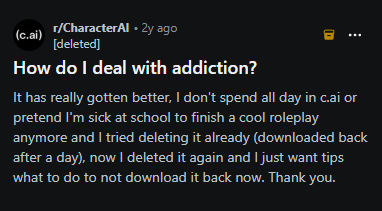
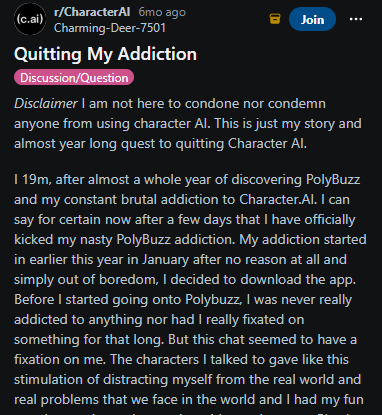
Below are screenshots of real users of the popular service Character.AI describing their addiction.
"I need people 24/7 so I actively seek out anything I can talk to."
One of our own users
People are clearly becoming addicted, but why? We reviewed a range of r/CharacterAI posts and mapped out the most common reasons.
The most common factor is a pre-existing vulnerability, such as depression, social anxiety, or weak social connections, which lets the addiction take root in the first place. What turns use into addiction is usually one of the following:
- Emotional validation: People feel more seen and understood when talking to the AI than when talking to real people.
- Substitution for real relationships: Many people feel as if they were an AI themselves, which makes their relationship with the AI feel more genuine.
- No conclusion: The stories never end, so there is never a natural point to stop.
- Reward cycle: Talking to an AI gives the same mental rewards as talking to a person, without the friction or the risk of negative feelings.
- Attachment: Users become attached to their chats and stories, and deleting one they cared about feels like a loss.
All of these help create and sustain an addiction, but every one of them depends on the user having a pre-existing vulnerability and being unable to find the same feeling outside of chatting.